

When we hear admonitions to avoid certain foods, generally those warnings relate solely to our internal health.
We hear of sugars, fast food, and refined carbs as threatening to the health of our heart, or detrimental to our gut health.
Now, I’m not saying those things aren’t true, and I’m not saying those aren’t greatly important. But, how often do you hear warnings regarding how certain foods can affect the way you look?
And, I’m not talking about your waistline either.
Many individuals lament the way their looks change as they age.
We don’t like to find extra lines or wrinkles on our face. We don’t appreciate the cellulite that seems to be more noticeable on our thighs and butt, and we try to hide the areas that now sag (that used to be firm).
But, is it just age that brings about these often unwanted changes?
Can the foods you eat contribute to wrinkles? Could those same foods that threaten your internal health affect your skin, aging you more rapidly?
The short answer…YES!
Various foods can definitely accelerate the aging process within your body, destroying collagen and leaving you looking older.
Below, you’ll find the top three categories of food that you should avoid…
1- Sugar And Refined Carbs
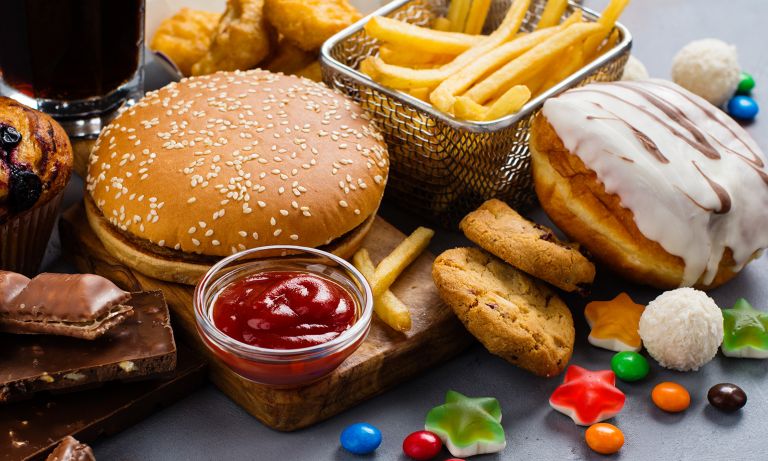
Sweets are a weakness for many people. Actually, according to some polls, over half of Americans admit to having a sweet tooth.
We often think of that sweet tooth contributing to expanding waistlines, but how else can it affect our bodies?
Consuming processed sugars can actually make you look older! And, unfortunately we’re not talking in terms of sophistication here. No, we’re talking about wrinkles!
One European study measured the blood sugar levels of a group of individuals. They took photos of these participants and showed those photos to another group. This group was tasked with assessing the age of the individuals in the photos.
Across the board, those individuals with higher blood sugar levels were presumed to be older than those individuals with lower blood sugar.
The advice of one cosmetic dermatologist regarding sugar consumption in relation to aging? “There is no point in spending lots of money on expensive skin creams if you are eating a diet high in sugar.”
So, studies prove it, and experts echo those findings…but why is it that sugar can have such negative effects on how quickly we age?
Collagen is a protein found in nearly one third of all of the tissues within your body. It provides both structure and elasticity.
The middle layer of your skin is made up primarily of collagen. Your skin’s smoothness, firmness, and ability to stretch is all due to that collagen.
But, as you age, your body’s collagen production declines. This is why your skin loses that smoothness, firmness, and ability to stretch as you get older. In practical terms, this is why your skin wrinkles, dimples, and sags with age.
Sugar latches on to proteins in your body, plain and simple. So, collagen, that oh-so abundant protein, is affected greatly by sugar consumption.
When you eat foods like cakes, cookies, pastries, and candies, or drink sugary sodas and other such beverages, that sugar attaches to protein and then produces harmful molecules known as advanced glycation end products or glycotoxins.
These toxins essentially render your skin’s collagen ineffective. So, you lose firmness, smoothness, and elasticity in your skin making you look older.
Glycotoxins also cause inflammation, which is another enemy to your body’s collagen levels.
Chronic inflammation causes enzymes within your skin cells to break down collagen and hinder its production.
And, perhaps we’re combining two food categories into one here, but refined carbs are just as detrimental to your skin as sugar. Why? Because white breads and pastas, cereals, and classic junk foods (chips, pretzels, and even rice cakes) are all processed foods that turn to glucose.
Essentially, these items turn to sugar and we’re once again squaring off with public enemy number one when it comes to collagen and the health and youthful appearance of your skin.
2- Processed Meats

Avoid These 3 Collagen-Destroying Foods. Processed meats include items like hot dogs, pepperoni, bacon, sausage, and lunch meats. These items are generally high in saturated fats and contain nitrates which can be toxic.
As these toxins are introduced into your digestive tract, your immune system goes into action producing an inflammatory response.
The inflammation that occurs, as in the case of sugar, causes a breakdown in collagen and an inhibition of its production.
So, technically, when consuming these collagen-destroying foods, you are enhancing what already happens with age: a decline in collagen production and effectiveness which can be seen clearly in the mirror (wrinkles, fine lines, and sagging, dimpled skin)
3- Fried Foods
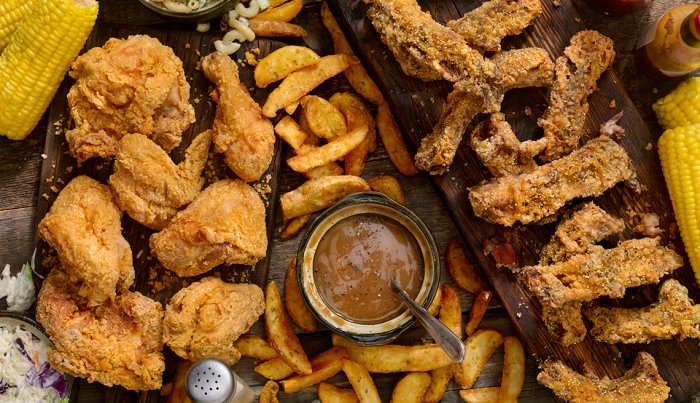
Foods that are fried at high temperatures, and especially those fried in unhealthy refined oils, when consumed, trigger the release of free radicals within your body.
Free radicals cause damage to the cells in your skin. When certain areas of your body are subjected to free radicals, an action called cross-linking occurs.
Cross-linking speeds up the process of aging and weakens the elasticity of your skin, making you look older.
Another way fried foods age you more rapidly is due to their salt content. Too much salt dehydrates your skin making you more prone to…you guessed it, wrinkles! (This is also true of the processed meats that we mentioned earlier.)
Avoiding fried foods can help you avoid premature aging!
https://www.dailymail.co.uk/femail/article-2125217/How-giving-sugar-20-years-looks.html
https://www.delish.com/food-news/g3553/14-foods-that-could-be-causing-wrinkles/?slide=7
https://pmc.ncbi.nlm.nih.gov/articles/PMC4648888/
https://www.healthline.com/health/food-nutrition/food-cause-wrinkles
https://www.ncbi.nlm.nih.gov/pmc/articles/PMC3704564/