
Most people assume fatty liver disease is something that happens to heavy drinkers. It’s one of the most common misconceptions in liver health. The truth is, the most prevalent form of this condition has nothing to do with alcohol at all.
It’s called nonalcoholic fatty liver disease, or NAFLD, and it affects an estimated 30 to 40 percent of adults in the United States alone. (1) Many of them don’t know they have it.
Understanding what’s behind NAFLD, and what you can actually do about it, is genuinely worth your time. The liver is one of the body’s hardest-working organs, and when it’s struggling, the effects tend to show up in ways that feel frustratingly vague. If supporting your liver has been on your mind lately, learning how daily habits influence liver function is often the best place to start.
What Nonalcoholic Fatty Liver Disease Actually Is
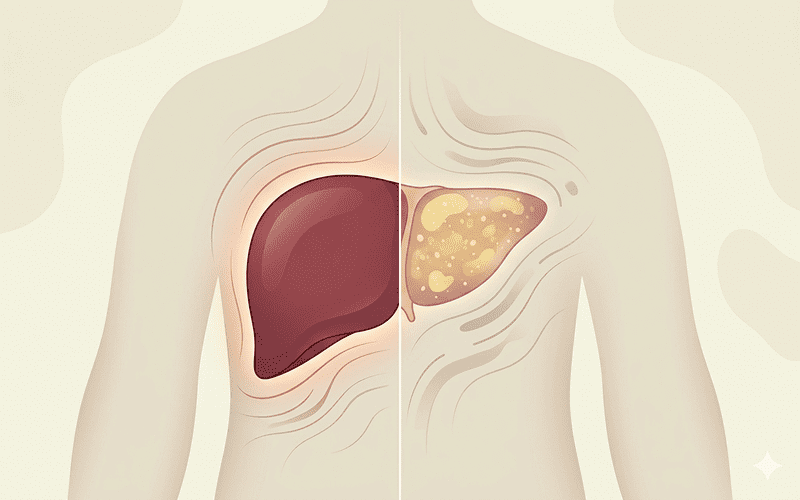
The liver naturally contains a small amount of fat. That’s normal. The problem begins when fat accumulates in more than five to ten percent of the liver’s weight, which is when it starts to interfere with normal function. (2)
NAFLD is actually an umbrella term that covers two distinct conditions:
Simple fatty liver (steatosis): Fat has built up, but there’s little or no inflammation and liver cells aren’t significantly damaged. Most people with this form don’t progress to more serious complications.
Nonalcoholic steatohepatitis (NASH): This is the more serious form. Fat accumulation is accompanied by inflammation and cell damage. Over time, NASH can lead to fibrosis (scarring of liver tissue), cirrhosis, or in some cases, liver cancer.
The distinction matters because most people with simple fatty liver won’t notice it at all. But without lifestyle changes, some will gradually progress toward NASH, which is why catching it early, and understanding the root causes, is so important.
What’s Really Driving NAFLD
This is where things get interesting. NAFLD is closely tied to several common metabolic conditions, many of which are quietly affecting millions of people who don’t realize their liver is involved. (2), (3)
The most significant risk factors include:
- Obesity, particularly when excess weight is concentrated around the abdomen
- Type 2 diabetes and insulin resistance, which are among the most consistent drivers of NAFLD
- High triglycerides and elevated cholesterol levels
- Metabolic syndrome, which is defined as having at least three of the following: high triglycerides, low HDL (“good”) cholesterol, high blood pressure, elevated blood sugar, or a large waist circumference
- Polycystic ovary syndrome (PCOS)
- Underactive thyroid (hypothyroidism)
There’s also emerging research suggesting genetics may play a role, though scientists are still working to understand exactly how and how much.
A few less obvious contributors are worth knowing about: rapid weight loss, certain medications including some prescribed for seizures, heart conditions, and cancer treatment, and exposure to certain environmental toxins have all been linked to liver fat accumulation in some cases. (3)
One thing that often surprises people: NAFLD isn’t only an adult condition. According to the National Institutes of Health, close to 10 percent of U.S. children and teenagers between ages 2 and 19 have NAFLD, a number that has grown alongside rising childhood obesity rates.
When the Liver Starts to Show It
Here’s what makes NAFLD easy to miss: it usually causes no symptoms in its early stages. A lot of people discover it during routine blood work or imaging done for something else entirely.
When symptoms do appear, they tend to be nonspecific. Fatigue is common. Some people notice a dull ache or sense of heaviness in the upper right side of the abdomen. An enlarged liver may be detected during a physical exam.
As the condition progresses toward NASH or cirrhosis, signs become more noticeable and serious. These can include yellowing of the skin or eyes (jaundice), abdominal swelling, unexplained weight loss, weakness, and visible changes to the skin and blood vessels.
If any of these sound familiar, talking to your doctor is the right next step. NAFLD is diagnosed through blood tests, imaging, and sometimes a liver biopsy, not through symptoms alone.

The Good News: Lifestyle Makes a Real Difference
Here’s something worth holding onto: NAFLD is one of those conditions where lifestyle changes can genuinely move the needle. There’s no approved medication specifically for NAFLD or NASH as of now, which means the foundational treatment is exactly the kind of thing that doesn’t require a prescription. (4), (5)
Modest weight loss goes a long way. Research shows that losing just three to five percent of body weight can significantly reduce fat in the liver. Getting to seven to ten percent loss can also help reduce inflammation. (6), (7) The key word is gradually. Rapid weight loss, particularly through very low calorie diets or extended fasting, can actually worsen NAFLD rather than help it.
What you eat matters more than most people realize. A diet built around vegetables, fruits, whole grains, and healthy fats while limiting sugar, refined carbohydrates, and saturated fats is consistently associated with better liver outcomes. Soft drinks and fruit juices high in fructose are worth cutting back on specifically, as excess fructose is directly processed by the liver. Replacing red and processed meats with fish is a worthwhile swap for many people. (8)
Some research suggests that certain foods may offer additional benefit. Omega-3 fatty acids, soy protein, and probiotic-rich foods have shown promise in NAFLD management, and green tea components appear to offer some preventive effects. (9) Coffee is a curious one: multiple studies have found that people with NAFLD who drink coffee regularly tend to show less liver damage than those who don’t, though researchers are still working to understand why. (2)
Exercise is one of the most effective tools available. Aiming for at least 150 minutes of moderate activity per week, like walking, cycling, or swimming, is a good target. Recent research suggests that combining aerobic exercise with resistance training may be more effective than aerobic exercise alone. (7)
Managing underlying conditions is equally important. Blood sugar control, cholesterol management, and blood pressure all feed into liver health. Addressing these in partnership with a healthcare provider helps address NAFLD from multiple angles at once.
If you smoke, that’s another lever worth pulling. Smoking elevates cardiovascular risk in people with NAFLD, and reducing that risk matters as the condition progresses.
If you’re looking for additional support alongside these lifestyle efforts, some people find that exploring options specifically designed to support liver function can be a helpful complement to what they’re already doing. For some people, adding targeted liver support alongside healthy eating and exercise can make staying consistent feel easier.

Learn More About Liver Support
The Gut-Liver Connection
One area of growing research deserves a mention here. Scientists are increasingly interested in the relationship between gut health and liver health. The gut and liver are in constant communication, and evidence suggests that disruptions in the gut microbiome, the vast community of bacteria living in the digestive tract, may contribute to the development and progression of NAFLD. (10)
Probiotics may play a helpful role in this picture by supporting a healthier microbial environment, which in turn may reduce some of the inflammatory signals that travel from the gut to the liver. This is still an evolving area of research, but it’s a meaningful one, especially given how much attention gut health is receiving across many areas of wellness.
Putting It Together
NAFLD is common, often silent, and closely tied to the same lifestyle factors that drive many other chronic health concerns. That’s frustrating in one sense, but it’s also genuinely encouraging, because it means the same habits that support overall health, eating well, moving regularly, managing weight gradually, keeping stress in check, also work to protect the liver.
No single change works overnight. Most people see improvement through a collection of small, consistent shifts rather than one dramatic overhaul. That’s actually how lasting change tends to happen.
Supporting your liver doesn’t have to feel overwhelming. Starting with the basics, and building from there, is usually enough to get things moving in the right direction.
If you’re building healthier habits already, adding extra support may simply help reinforce the work you’re putting in every day. Exploring ways to support liver function naturally can be one more tool alongside better nutrition, movement, and long-term consistency.
Learn More About Liver Support
Sources
[1] Younossi ZM, et al. Global epidemiology of nonalcoholic fatty liver disease. Hepatology. 2016. https://doi.org/10.1002/hep.28431
[2] Mayo Clinic. Nonalcoholic Fatty Liver Disease. https://www.mayoclinic.org/diseases-conditions/nonalcoholic-fatty-liver-disease/symptoms-causes/syc-20354567
[3] National Institute of Diabetes and Digestive and Kidney Diseases (NIDDK). Symptoms and Causes of NAFLD and NASH. https://www.niddk.nih.gov/health-information/liver-disease/nafld-nash/symptoms-causes
[4] American Liver Foundation. NAFLD. https://liverfoundation.org/liver-diseases/fatty-liver-disease/nonalcoholic-fatty-liver-disease-nafld/
[5] Caporaso N, et al. Dietary approach in the prevention and treatment of NAFLD. Frontiers in Bioscience. 2012. https://doi.org/10.2741/4049
[6] Fan JG, Cao HX. Role of diet and nutritional management in non-alcoholic fatty liver disease. Journal of Gastroenterology and Hepatology. 2013. https://doi.org/10.1111/jgh.12244
[7] Oh H, et al. Non-alcoholic fatty liver diseases: update on the challenge of diagnosis and treatment. Clinical and Molecular Hepatology. 2016. https://doi.org/10.3350/cmh.2016.0049
[8] Zelber-Sagi S, et al. Nutrition and physical activity in NAFLD: an overview of the epidemiological evidence. World Journal of Gastroenterology. 2011. https://doi.org/10.3748/wjg.v17.i29.3377
[9] Xiao J, et al. Recent advances in the herbal treatment of non-alcoholic fatty liver disease. Journal of Traditional and Complementary Medicine. 2013. https://doi.org/10.4103/2225-4110.110411
[10] Doulberis M, et al. Non-alcoholic fatty liver disease: an update with special focus on the role of gut microbiota. Metabolism. 2017. https://doi.org/10.1016/j.metabol.2017.03.013