

Most people do not walk into a doctor’s office expecting to hear the words fatty liver disease.
Sometimes it starts with routine blood work. Sometimes it starts with an ultrasound ordered for something completely unrelated. Sometimes people feel perfectly fine and are surprised when a doctor mentions fat buildup in the liver during a regular appointment.
That confusion is understandable.
Fatty liver disease often develops quietly. Many people have no symptoms early on, which means diagnosis usually depends on a combination of medical history, blood work, imaging, and sometimes more specialized testing.
Doctors are not only trying to determine whether fat is present in the liver. They are also trying to understand whether inflammation, scarring, or more advanced damage may already be happening.
Why Doctors Usually Start With Questions
Before scans or procedures, doctors usually begin with your health history.
They may ask whether you have:
- Type 2 diabetes
- High blood pressure
- High triglycerides
- Elevated cholesterol
- Metabolic syndrome
- Insulin resistance
- Sleep apnea
- Weight gain over time
- Family history of liver disease
Your doctor may also ask about:
- Alcohol intake
- Exercise habits
- Typical diet
- Sleep patterns
- Current medications
- Supplements
- Smoking history
These questions matter because fatty liver disease is strongly connected to metabolic health. According to the National Institute of Diabetes and Digestive and Kidney Diseases, diagnosis often starts by reviewing risk factors and medical history before moving to testing.(1)
Alcohol questions matter too. Fat buildup caused by alcohol and fat buildup related to metabolic dysfunction can appear similar on imaging, so context matters.
What Happens During The Physical Exam
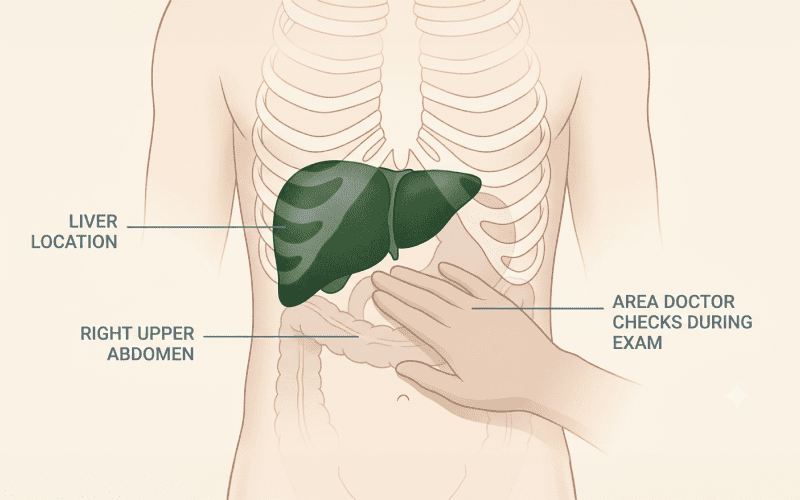
A physical exam alone cannot diagnose fatty liver disease, but it helps doctors look for clues.
Your provider may:
- Check weight and height
- Calculate body mass index
- Measure waist circumference
- Press below the right rib cage to feel liver size
- Check for physical signs of insulin resistance or liver disease
Doctors may look for signs such as:
- Darkened patches of skin around the neck or joints
- Yellowing skin or eyes
- Abdominal swelling
- Tenderness beneath the ribs
- Liver enlargement
Many people with fatty liver disease have none of these signs.
That quiet nature is one reason diagnosis sometimes happens later than people expect.
Blood Tests Often Provide The First Clue
Blood work is frequently where fatty liver disease first appears.
Doctors commonly evaluate:
- ALT (alanine aminotransferase)
- AST (aspartate aminotransferase)
Elevated levels may suggest liver stress or liver cell damage.
But elevated liver enzymes do not automatically mean fatty liver disease.
Doctors may order additional testing because liver enzyme changes may also occur with:
- Viral hepatitis
- Certain medications
- Thyroid disorders
- Autoimmune diseases
- Alcohol use
- Iron overload disorders
One thing many people do not realize is that normal liver enzymes do not always rule fatty liver disease out.
Some people with liver fat still have blood work that appears relatively normal.(2)
That is why doctors rarely rely on a single number.
Imaging Tests Help Doctors See What Blood Work Cannot
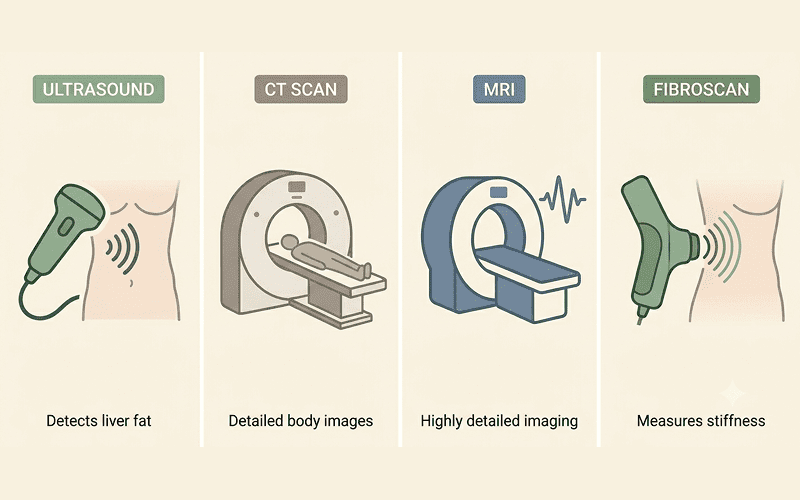
If blood work raises concerns, imaging often comes next.
Ultrasound
Ultrasound is commonly used first.
It:
- Uses sound waves
- Does not use radiation
- Is painless
- Can identify moderate to severe liver fat
Ultrasound is often used because it is accessible and relatively inexpensive.(1)
CT Scan
CT scans use X-rays and computer imaging technology to create detailed pictures.
Doctors may order CT scans when:
- Other abdominal conditions are being evaluated
- Additional detail is needed
- More structures need to be examined
Sometimes contrast dye is used to improve image clarity.
MRI
MRI uses magnets and radio waves rather than radiation.
MRI may:
- Estimate liver fat more accurately
- Provide detailed images
- Clarify uncertain findings
MRI tends to be more expensive, so it is usually not the first test ordered.(3)
FibroScan And Elastography
Some providers now use transient elastography, commonly called FibroScan.
FibroScan:
- Measures liver stiffness
- Helps estimate fibrosis risk
- Uses painless vibration waves
- Does not require needles
This matters because doctors want to know more than whether fat exists. They want to understand whether scarring may already be developing.(4)
Why Fat Alone Does Not Tell The Whole Story
Finding fat in the liver is important.
But doctors also want answers to bigger questions:
- Is inflammation present?
- Is scarring starting?
- Has liver tissue been damaged?
This is why diagnosis often goes beyond simple imaging.
Simple Fatty Liver
Fat is present, but inflammation and scarring are minimal or absent.
NASH
Fat is present alongside inflammation and liver cell injury.
Fibrosis
Scar tissue has started forming.
Cirrhosis
Extensive scarring begins changing liver function.
The earlier these stages are recognized, the more opportunities people often have to improve outcomes.
When A Liver Biopsy Might Be Recommended

Many people become nervous when biopsy comes up.
Fortunately, most people never need one.
Doctors may recommend biopsy when:
- Significant fibrosis is suspected
- Imaging results are unclear
- Advanced disease appears possible
- More precise staging is needed
During biopsy:
- Skin is numbed
- A small needle removes tissue
- Specialists analyze the sample under a microscope
Biopsy remains one of the most accurate ways to evaluate inflammation and fibrosis severity.(5)
Because biopsy is invasive, doctors generally reserve it for situations where additional information is truly needed.
What Happens After Diagnosis?
Getting a diagnosis can bring relief, frustration, worry, or all three at once.
For many people, treatment focuses on improving metabolic health while reducing stress on the liver.
Doctors commonly recommend:
- Weight reduction when appropriate
- Lower added sugar intake
- Increased fiber consumption
- Better blood sugar control
- More physical activity
- Improved sleep habits
- Cholesterol management
- Reducing alcohol intake
Research continues to show that sustained lifestyle improvements may significantly reduce liver fat and improve liver health over time.(1)
Many people find it helpful to combine lifestyle changes with additional wellness approaches that align with their health goals. Exploring supportive approaches may provide another layer of encouragement while working on long-term habits.
Learn More About Liver Support
A Realistic Takeaway
Fatty liver disease rarely announces itself loudly.
That is part of why testing matters.
Blood work, imaging, physical exams, and sometimes specialized testing each provide different pieces of information. Together, they help doctors understand whether fat, inflammation, or scarring may be present.
The process can feel intimidating at first.
Understanding what the tests are measuring often makes the experience easier to navigate.
Improving liver health usually is not about perfection. It is often about understanding what your body needs, making small changes consistently, and finding support that fits your lifestyle.
If you are looking for additional ways to support liver wellness alongside healthy habits and medical guidance, exploring supportive options may be a helpful next step.
Learn More About Liver Support
Sources / References
[1] National Institute of Diabetes and Digestive and Kidney Diseases. Diagnosis and Treatment of NAFLD and NASH
https://www.niddk.nih.gov/health-information/liver-disease/nafld-nash/diagnosis
https://www.niddk.nih.gov/health-information/liver-disease/nafld-nash/treatment
[2] Cleveland Clinic. Fatty Liver Disease Overview
https://my.clevelandclinic.org/health/diseases/15831-fatty-liver-disease
[3] Mayo Clinic. Fatty Liver Disease Diagnosis and Treatment
https://www.mayoclinic.org/diseases-conditions/fatty-liver-disease-masld/diagnosis-treatment/drc-20354573
[4] American Association for the Study of Liver Diseases Practice Guidance
https://pmc.ncbi.nlm.nih.gov/articles/PMC10735173/
[5] Mayo Clinic. Liver Biopsy Overview
https://www.mayoclinic.org/tests-procedures/liver-biopsy/about/pac-20394576